
The Confusion Is Real — And It's Costing Travelers Money
If you've ever Googled "do I need a travel adapter or voltage converter," you've probably ended up more confused than when you started. Most articles get technical fast, and before you know it, you're reading about hertz, wattage, and AC/DC current instead of getting a simple answer.
We're going to fix that right now. No engineering degree required.
The Simple Version: What Each One Does
Think of it this way:
- A plug adapter — changes the shape of your plug so it physically fits into a foreign outlet. That's it. It's like a translation tool for the prong shape.
- A voltage converter (also called a power converter) actually changes the electrical current — converting, say, 230V to 110V or vice versa — so your device gets the right power level.
Do You Actually Need a Voltage Converter in 2025?
Here's the part that surprises most people: almost certainly not.
The vast majority of modern electronics — smartphones, laptops, tablets, cameras, earbuds, electric shavers, hair straighteners — are built with what's called a dual-voltage or multi-voltage power supply. This means they automatically adjust to whatever voltage the local grid is running at, whether that's 100V (Japan) or 240V (Australia).
How do you check? Look at your charger brick or the back of your device. If it says something like "INPUT: 100–240V, 50/60Hz," you're good to go worldwide with just an adapter.
When DO You Need a Converter?
Converters become relevant for older, single-voltage appliances — things like:
- Older hair dryers or curling irons (the ones that aren't labeled dual-voltage)
- Some vintage electronics
- Cheap power tools or appliances without multi-voltage capability
But here's the honest truth: if you're under 35 and traveling with a laptop, iPhone, USB-C peripherals, and maybe a camera, you almost certainly do not need a voltage converter. You just need a good adapter.
Side-by-Side Comparison
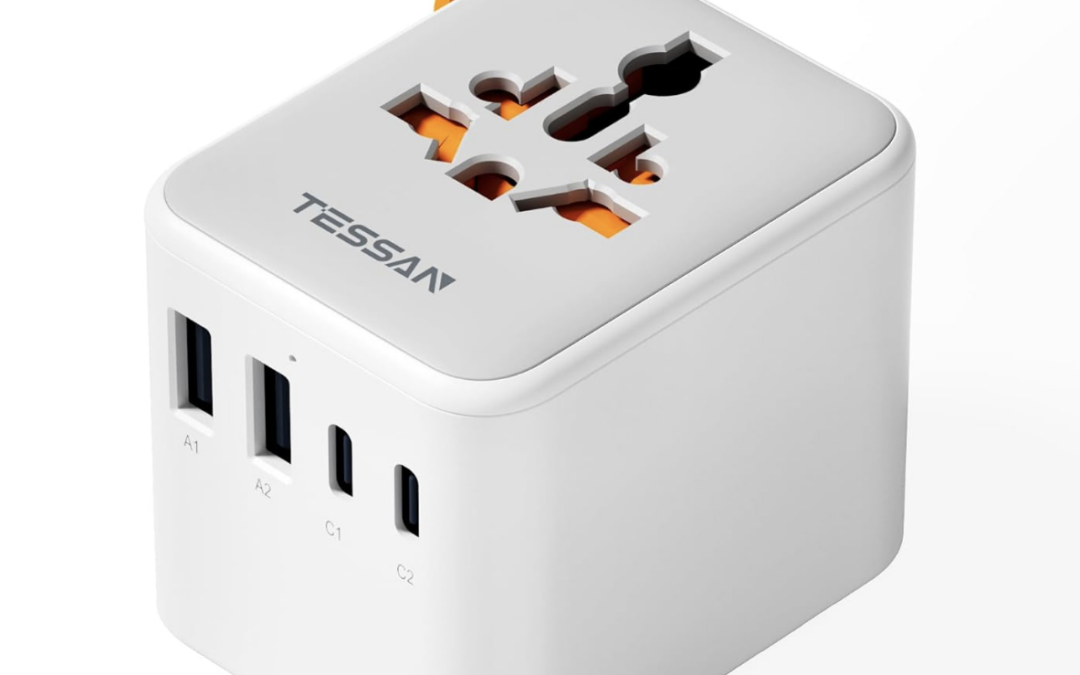
Universal Plug Adapter (e.g., TESSAN)
- Changes the plug shape to fit the local outlet
- Lightweight and compact (fits in your pocket)
- Works for all dual-voltage modern electronics
- Includes 4 USB-A and 2 USB-C ports for direct device charging
- Price range: €20–40
- Who needs it: Everyone traveling internationally
Voltage Converter
- Changes the actual electrical voltage of the current
- Heavy and bulky (some weigh over 1kg)
- Necessary only for older/single-voltage appliances
- No USB ports — just a plug socket
- Price range: €25–100+
- Who needs it: People traveling with vintage or single-voltage appliances
The Verdict: What Should You Buy?
If you're a modern traveler packing a phone, laptop, tablet, and USB-charged accessories — buy a universal plug adapter and skip the converter entirely. The TESSAN Universal Travel Adapter covers everything you need for a fraction of the bulk and cost.
If you're also bringing an older hair dryer that isn't labeled "dual voltage," either buy a travel-friendly dual-voltage hair dryer (honestly, worth it for frequent travelers) or grab a small converter just for that one device. Most hotels also provide dual-voltage hair dryers in the bathroom, so check before you pack one.
"Quick Test: Look at your charger. Does it say "100–240V"? If yes, you only need an adapter — not a converter. TESSAN has you covered."
Why TESSAN Is the Right Adapter for This Job
The TESSAN Universal Travel Adapter isn't just a shape converter — it's a full charging hub. With 4 USB-A ports, 2 USB-C ports, and compatibility with 150+ countries, it means you can:
- Plug your laptop charger into the wall outlet
- Charge your phone and earbuds via USB simultaneously
- Have spare ports for a travel companion
One device, multiple devices charged. That's the TESSAN difference.
💡 Pro move: Before any international trip, photograph the label on each charger/device you're packing. If they all say "100–240V," you only need one TESSAN adapter and nothing else.