
You're Going. Now Figure Out What to Actually Pack.
Congratulations — you got into your study abroad program. Whether you're heading to London, Barcelona, Seoul, Cape Town, or anywhere in between, the next few months are going to be some of the best of your life.
But first, you have to pack. And not just clothes, you need the right tech. The wrong gadgets (or missing the right ones) can turn an amazing semester into a frustrating, overcharged, dead-battery mess.
Here's the no-BS guide to the 5 tech gadgets you actually need for study abroad, ranked by how much your life will fall apart without them.
#1: Universal Plug Adapter (Non-Negotiable)
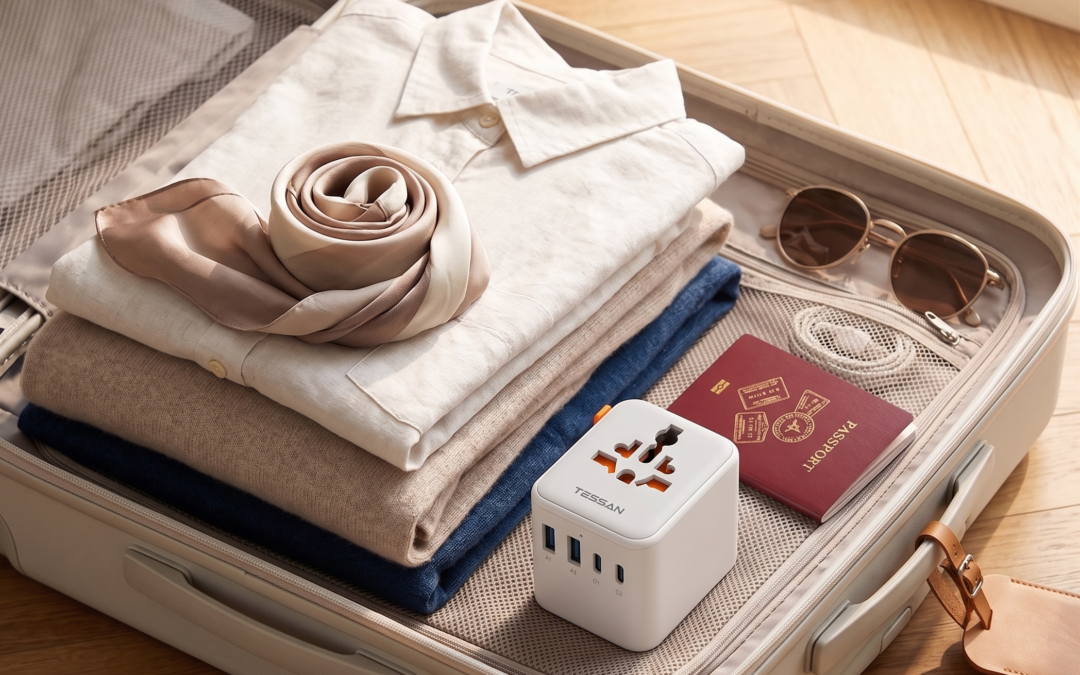
Let's not bury the lede. The TESSAN Universal Travel Adapter is the single most important piece of tech you can bring on a study abroad program. And this isn't sponsored hyperbole, it's just physics.
Every country runs on a different electrical standard. Your US or Canadian chargers will not fit into outlets in Europe, Asia, Australia, or most of the world. Full stop. Without an adapter, nothing charges. Without charging, nothing works.
But the TESSAN doesn't just solve the plug problem, it turns one wall outlet into a personal charging station. With 4 USB-A ports and 2 USB-C ports, you can charge your phone, laptop, earbuds, and camera simultaneously. In a student dorm where you might be sharing limited outlets with roommates, this is a literal lifesaver.
- Compatible with — 150+ countries
- Ports — 4x USB-A + 2x USB-C + 1 universal AC socket
- Weight — Under 200g
- TSA-friendly — Yes
- Price — ~€20 on Amazon
"My TESSAN adapter was genuinely the best thing I packed for my semester in Florence. Used it every single day. Study abroad student, Instagram review"
#2: Lightweight Laptop (MacBook Air or Windows Equivalent)
You're going abroad to study — which means essays, research, presentations, and probably a lot of Netflix in between. A lightweight laptop (ideally under 1.5kg) is essential. The MacBook Air M2/M3 is the gold standard for study abroad: incredible battery life, light, and the USB-C charger plugs directly into the TESSAN adapter.
Windows users: the Dell XPS 13 or Lenovo IdeaPad Slim 5 are excellent, lighter-weight alternatives. Whatever you bring, make sure your charger brick says "100–240V," so it works worldwide with just an adapter (no converter needed).
#3: 20,000mAh Power Bank
Port days. Long travel days. Field trips. Museum visits where there's no outlet in sight. A high-capacity power bank is your insurance policy for staying connected when you can't get to a wall outlet.
20,000mAh is the sweet spot — it'll fully charge an iPhone 5–6 times, and it's big enough to top up your laptop in a pinch. Charge it every night via your TESSAN adapter so it's always full.
Look for one with USB-C input and output (for faster charging) and at least 20W output. Anker and Baseus make excellent options in the €35–50 range.
- Anker PowerCore 20100 — Reliable, widely available
- Baseus Power Bank 20,000mAh — USB-C, compact design
- Mophie Powerstation — Slightly pricier but premium build
#4: Noise-Cancelling Earbuds
Study rooms, hostels, overnight trains, noisy flat-mates, language barrier situations where you just want to disappear into a podcast, noise-canceling earbuds are not a luxury for study abroad students. They're essential.
The AirPods Pro (if you're in the Apple ecosystem) or Sony WF-1000XM5 are the benchmark options. If you're on a tighter budget, the Nothing Ear 2 or EarFun Air Pro offer excellent ANC at half the price.
And yes — they charge via the USB-C port on your TESSAN adapter.
#5: Unlocked Dual-SIM Smartphone (Or a Cheap Local SIM)
Data abroad is where students get destroyed financially. Roaming charges on a US plan can run $10+ per day. The smart move is either:
- Get an eSIM or local physical SIM in your destination country — Available at airports, carrier stores, or via apps like Airalo. This gives you local data at local prices.
- Check if your carrier includes international data — T-Mobile Magenta includes some international data in 215+ countries. It's slower, but free.
- Buy an unlocked budget Android phone abroad — In many countries (especially Southeast Asia and Eastern Europe), decent unlocked smartphones are surprisingly cheap.
Whatever option you choose, make sure your phone is unlocked before you leave. Call your carrier. Do this before you get on the plane.
Bonus: The Stuff You Should Leave at Home
Equally important to what to pack: what NOT to bring.
- Power Strip or Extension Cord with Surge Protector — It's dangerous abroad and will likely be confiscated at customs or the dorm check-in. Use your TESSAN instead.
- Single-Voltage Hair Dryer — It will fry itself and possibly the outlet. Buy a dual-voltage travel dryer or use the one in the dorm bathroom.
- Bulky Camera Tripod — You'll use it twice and regret carrying it. Trust us.
- Multiple Separate Charging Cables — A 3-in-1 cable handles everything. Minimise.
The Complete Study Abroad Tech Packing List
- TESSAN Universal Travel Adapter — #1 priority — get this first
- Lightweight laptop + USB-C charger
- 20,000mAh power bank (USB-C in/out)
- Noise-canceling earbuds
- Unlocked smartphone with eSIM or local SIM plan
- 3-in-1 charging cable (USB-C / Lightning / Micro-USB)
- Portable laptop stand (your neck will thank you)
- Compact Bluetooth speaker (for the hostel common room era)
You're More Prepared Than You Think. Now Go.
Study abroad is genuinely life-changing. You're going to discover new cities, new friends and new versions of yourself. But none of that happens if your devices are dead and you're stuck at the front desk asking to borrow a charger.
Get the TESSAN adapter. Charge everything. Then go live the semester.
💡 Final tip: Add the TESSAN adapter to your Amazon cart now, before you start the rest of your packing. It's the one thing you can't improvise on the fly when you land, and it's the piece of gear you'll use every single day abroad.